
Ruth Phypers
Buddy & Advocate
“The report appeared in the News of the World: Sex and Drugs on AIDS Training Weekend. Suddenly we were all under the spotlight and it wasn’t fair. Volunteers had put in so much.”
Short Video
Extended Version
Related Videos
All Video Categories
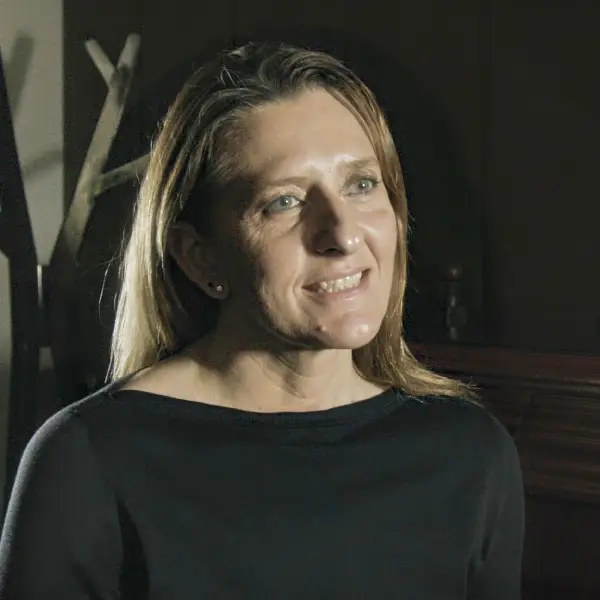
Ruth Phypers supported the AIDS community as a Terrence Higgins Trust Buddy and also trained other Buddies in the 1990s. She is now an author who also works to educate the public and healthcare professionals about natural alternatives for pain relief and trauma. She describes the Buddy system and training, and her experiences with two different Buddies, Paul and Andrew.
Full story
I graduated from university in 1989 and headed straight for London. The early nineties was a hedonistic time. It was easy to jump on that party train. On a Saturday night, Troll, a great dance club, around the back of Heaven, was the place to be. The drugs were recreational, the dancing was fun, and life was one big party. But it was in Troll that I met a trustee of the Terence Higgins Trust. I’d knew about HIV from a gay friend on my Theatre course who’d devised a piece called Ten Days: the length of time it took to get HIV results back. I was shocked that people my age were facing a terminal illness with no cure.
‘What can I do to help?’ I asked the trustee.
‘You’d make a really good Buddy,’ he said.
A Buddy was an advocate, on the side of someone with HIV. I found myself on a Buddy training weekend learning about the illness, exploring the stigma, discussing boundaries, confidentiality and anonymity, as well as death and our own mortality. I had nights where I didn’t dare sleep, paralysed by the reality of my own existence, worried that I might not wake up. I’d never seen anybody die before and knew that it was likely to happen when I became someone’s Buddy. It was a powerful lesson to learn at just 22 years old.
It was straight in at the deep end.
‘Meet Paul at the Chelsea and Westminster where he’s having a blood transfusion. Take him home afterwards.’
At that first meeting it was as though we’d always known each other.
‘You’re my angel,’ he said.
Being a Buddy meant hanging out together. There were boundaries. We shouldn’t see our service users more than three times a week, nor stay at their house. I’d take Paul to medical appointments. Sometimes we’d go shopping. He’d been an antiques dealer and, when he was still well enough, we’d go antique-hunting.
Then his health declined rapidly. I’d visit him at the Lighthouse. Sometimes he got scared and begged me not to leave. He didn’t want to be alone overnight. As his health declined further, he wanted to talk about his death.
Once I said, ‘When you’ve gone, maybe you could just give me a sign that you’re still around. But don’t appear as a ghost because that would scare me.’
‘I’m very good with electricity,’ he replied. But he was also concerned about me and how I was going to cope after. He made me promise to get support.
One night I popped to see Paul in the Lighthouse on my way to a night out at Troll. His diarrhoea was bad and I remember a nurse mopping it up with me. We got him cleaned up and then I headed out for my evening.
‘Love you!’ he said.
‘Yeah, love you. See you tomorrow.’ That night, for some reason, I didn’t want to dance. Then, at about 5am, I got a call from the Lighthouse. He’d had a seizure. His face and skin tone had utterly changed. He didn’t look like Paul anymore. He was unconscious; like a waxwork that was still breathing. I sat with him, wondering if he could still hear. I thought about what I’d want to hear if this was me. I held his hand and told him he’d done nothing wrong. He didn’t deserve this but he was going to be going on a brilliant journey soon. He’d come back with some great stories.
Suddenly, colour rushed through his face and neck. His eyes opened and he looked straight at me. A tear ran down his face. It was as if he’d died and come back to life. ‘Oh my god! You can hear me!’ I shouted.
There was an amazing moment where I felt that somehow, everything was okay. He’d forgiven everyone. He’d forgiven himself.
And then, in this beautiful moment, he was sick.
‘Do you want more morphine?’ I asked, when he was settled again. ‘Just squeeze my hand twice.’
He did. I stayed with him. Throughout the day his breathing got slower and slower, and by 10pm he passed away. But I could still feel him in the room. I kept holding his hand while his body was warm.
Eventually I told myself that I had to leave. I needed to sleep. Because I’d been clubbing, I’d been up for the best part of 48 hours by now. My boyfriend drove us back to Islington. We lived on the third floor and, as I climbed the first set of stairs, the bulb blew when I flicked the switch. I went up the next set of stairs and that bulb blew. And the next. In the bathroom I switched the light on and that bulb blew. I fell to my knees in the pitch black. I knew that Paul hadn’t gone anywhere.
For the last seventeen years I’ve been a practising Buddhist, but the spiritual connection with Paul gave me the sense that when we die we join a greater collective energy. He’s still around sometimes, messing about with electricity in life’s difficult moments, when I need him the most. He promised to always be with me. ‘I’m going to wait your entire life and I’m going to be there when it’s your turn.’
But people at work, even my friends, didn’t really understand. The only people that did were other people within the AIDS community. More and more people were contracting the virus. I volunteered to start training Buddies. Once, a reporter infiltrated one of the training weekends. On Saturday night there were always a few drinks, though never any drugs that I knew of, but the report appeared in the News of the World: Sex and Drugs on AIDS Training Weekend. Suddenly we were all under the spotlight and it wasn’t fair. Volunteers had put in so much. One month I put in 100 hours of voluntary work for the THT on top of my full-time 40-hour a week job, swinging by the THT in the evening for a meeting, or going to see my Buddy, or getting together with the training team.
Another Buddy was William, a doctor. His partner, Andrew, was a dentist. William was adamant he didn’t need me. ‘I’ve got a partner, family and friends.’ He only ever called on me once, when he was in the Lighthouse and Andrew was away. It was a completely different experience to that first Buddy relationship. ‘You were exactly the person that I needed that night,’ he said, before he passed away.
Andrew also had AIDS and knew that he, too, was likely to die. He asked me to be his Buddy. ‘But I’m your mate anyway,’ I told him.
‘I want you there in an official capacity,’ he insisted.
Andrew had seen the way his partner died. His own quality of life was declining fast. Bereaved and living alone, his family hundreds of miles away, he’d managed to save enough morphine for a lethal dose and worked out how to administer it intravenously over 24 hours. ‘What else am I going to do? I’m going to die anyway. I’m going to be in pain. It’s going to be humiliating, degrading, and quite possibly really drawn out because I’m young. At least let me do it while I’m still able to have a joint before I go, and can say goodbye to my friends.’
They were persuasive arguments.
On Thursday he revealed his plan for the weekend.
‘I’d like you to be the one that finds my body on Sunday morning. You won’t be on your own.’
Part of the Buddy training stipulated complete confidentiality, though we couldn’t actively help someone to die. I was very upset but didn’t show it. It wasn’t about me. It was about Andrew, and supporting him in what he wanted to do. That’s what the Buddy relationship was for.
On Friday he invited me for a last cup of tea. I left him knowing that it was goodbye. On Sunday morning I drove over as I’d promised. A nurse answered the door. She wasn’t supposed to be there. Andrew was unconscious but alive. The dose should’ve been ten times more than he needed, but somehow it didn’t work.
He lived for another year, terribly depressed. He’d felt empowered when he made his decision but when it failed, he’d lost that power over his own life. He didn’t want to try again a second time. ‘I really hope that in your lifetime euthanasia will become legal,’ he told me.
But people stopped passing away. People did stop dying.
I cared deeply about Andrew. By the time he died, my own life was careering out of control. I was yet to realise that I had a certain amount of co-dependence going on. I desperately wanted to give and give and give. The party was still going on around me but it wasn’t the same as it was five years before. Drugs were no longer recreational. I was medicating against the emotional, physical and mental strain. It had begun to seep into my relationships, and my work. I was as burned out as Andrew’s ashes. Eventually I underwent bereavement counselling from the Red Admiral Project, then therapy. For a while I got things under control but later went into another spiral, and was in my late thirties by the time I went into 12-step recovery and full addiction therapy.
Still, those experiences enriched my life. In my twenties, when I might otherwise have been thinking only about myself, I was given the opportunity to think about others. Society still sees death as a taboo. I think we treat our animals better than we treat people. We have a long way to go in terms of how we look after our sick and elderly, how we talk about death, and how we empower people around death. It’s not easy to lose anyone that you care about, but it was a privilege to accompany people to their death.