

When we think of local archives we might imagine rich collections of letters and photographs, official records and maps stacked upon tall shelves in boxes bursting with stories from our local communities. However, certain histories – particularly those that relate to marginalised groups – may not always be as well-represented as we might expect.
Despite the profound impact HIV and AIDS had on communities in north east England – from the first diagnoses in the 1980s, to the ongoing activism today – there is surprisingly little preserved in the major regional archives. This isn’t because ‘nothing happened up North’, rather it reflects the painful context of the epidemic: stigma, marginalisation and a culture that often excluded HIV+, LGBTQ+ and health activism from the official record.
Here, I hope to provide an overview to the records I have found so far but also highlight what is missing – and why this might be. Above all, it will show the importance of initiatives like the National HIV Story Trust’s HIVstory project that aim to fill in the gaps, whilst also continuing the conversation around lived experiences of HIV at both a national and regional level.
What Is in the Archives – and What’s Missing
The north east of England is geographically vast, stretching from the rugged uplands of the Pennines to the dramatic North Sea coastline, with wide rural landscapes, historic market towns and major rivers like the Tyne, Wear and Tees shaping its character. Historically, the region was equally expansive, playing a pivotal role in Roman Britain, being an early centre of Christianity and a powerhouse of the Industrial Revolution through coal mining, steel production and ship building. These histories are very clearly represented and collected in archives around the North East, so when I started researching HIV and AIDS, I was intrigued as to what I might find.
The most valuable resource was a recent national survey undertaken by the West Sussex Records Office that asked for information about HIV archives across the country to highlight collections and to identify those that were vulnerable. The survey found that Northern Ireland, the North East and North West of England had low levels of archival records.
I have found through my preliminary research that there are two main archival collections: a selection of material at Tyne and Wear Archives and the Tyneside Campaign for Homosexual Equality (CHE) Archive held in Special Collections and Archives at Newcastle University.
Recently, I had the opportunity to look through the CHE Archive which contains a valuable and extensive collection of letters, newspaper clippings, pamphlets and flyers all related to the organisation. Whilst much of the CHE Archive focuses on LGBTQ+ activism of the late 1970s, it also contains histories of HIV and AIDS, especially ephemera such as postcards, leaflets and information booklets.
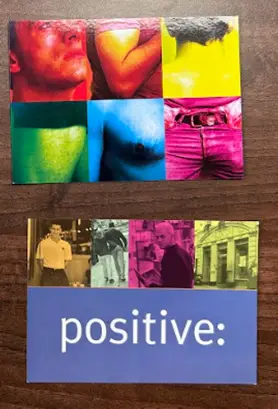
“Services for Gay and Bisexual Men in Kensington & Chelsea and Westminster”, Department of Health Promotion Kensington & Chelsea and Westminster Health Authority, “Positive:”, Body Positive, [CHE/03/05/06], [Tyneside Campaign for Homosexual Equality], Newcastle University Special Collections, GB 186.
Through my research, I discovered that the majority of the ephemera related to charities and organisations that worked nationally, such as Gay Men Fighting AIDS (GMFA), the Terrence Higgins Trust (THT) and the Health Education Authority. As these records came from the CHE, it was no surprise that these histories had a LGBTQ+ focus, particularly on gay men and men who have sex with men. This collection is rich in histories of how sexual health and HIV information was disseminated amongst individuals but it sadly tells us little about the personal stories of HIV and AIDS.
Secondly, although this Archive focuses on a North East organisation, I found only 3 pieces that related to and mentioned the North East, two of which came from the organisation MESMAC (MEn who have Sex with Men – Action in the Community) North East and one relating to the Northern Counties Trust, providing information on local helplines and groups. By looking at this collection, it is clear that more work needs to be done to tell the full story of HIV and AIDS, particularly in the North East.
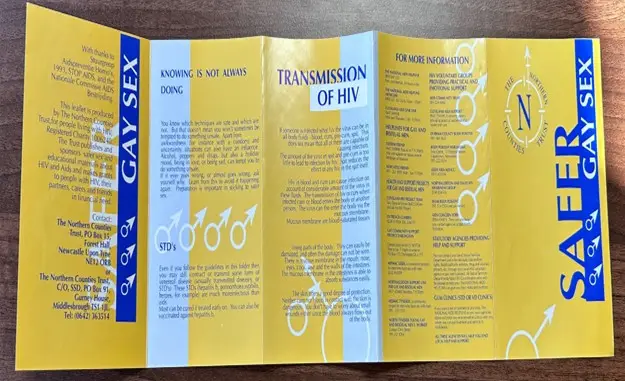
“Safer Gay Sex”, The Northern Counties Trust [CHE/03/05/06], [Tyneside Campaign for Homosexual Equality], Newcastle University Special Collections, GB 186.
1. Stigma and Silence
In the 1980s and 1990s, HIV and AIDS were deeply stigmatised. Many people lived in fear of discrimination and few had reason to donate or deposit personal material to local archives. Purposeful silencing has also played a role, such as with the Infected Blood Scandal, as many documents were poorly organised, sometimes destroyed or ‘lost’. Additionally, many of those living with and affected by HIV didn’t generally keep record of events as they were too focused on survival or personal tragedy; recording this time was not a priority.
2. Community Organising
Many of the organisations that supported people with HIV – volunteer groups, HIV and LGBTQ+ helplines and support networks – often operated with limited resources and informal and temporary structures. As a result, records were often not systematically preserved or archived. Also, histories relating to HIV organisations and charities often include ephemera, things that were made to be used and not last, such as pamphlets and flyers.
3. Archival Priorities
The limited presence of HIV-related material in the North East is likely the result of structural and institutional factors rather than an absence of local experience. Official archives have historically prioritised government and administrative records over community-produced materials, especially those relating to marginalised groups.
4. The Region
Compared with larger metropolises like London or Manchester, the North East has a smaller and more spread-out population. In the 1980s and 1990s, HIV cases were more concentrated in larger urban centres and so activist groups and major HIV charities were more visible in bigger cities and national media attention focused on where case numbers were highest. For many in the North, finding support and treatment of their condition was not widely available and so many patients would travel to London for their ongoing care and expert help. Therefore, a lot of experience of people living with HIV was observed in London, not necessarily in their home towns where support was scarce.
Filling in the Blanks
Organisations like the National HIV Story Trust have not only worked to fill in the gaps, they put the ‘lived experience’ first, focussing on the people most affected, allowing their voices to be heard. Without a fuller record, we lose a crucial opportunity to learn from past responses to stigma, illness and public health crises and to apply these learnings to current and future challenges. The history of HIV and AIDS in north east England may not yet be well represented in the archives, but that doesn’t mean it wasn’t real, important or deeply felt, It simply means that there’s work to do. By listening, collecting and preserving we can fill in those gaps and help ensure that this history finally takes its rightful place in our shared story.